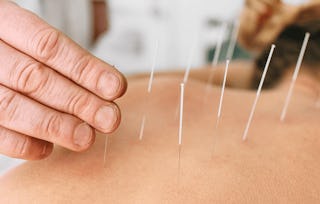
By the end of this course, you will (1) explain the fundamental theory of acupuncture and meridian systems and (2) demonstrate safe, ethical needling for general wellness. Led by Dr. Constance Bradley, L.Ac., PhD, this foundational course introduces Yin-Yang theory, Qi flow, and meridian pathways while emphasizing clean-needle technique and patient safety.

Enjoy unlimited growth with a year of Coursera Plus for $199 (regularly $399). Save now.

Essentials of Acupuncture: Theory & Practice
This course is part of Integrative Traditional Chinese Medicine Specialist Specialization

Instructor: Niel Asher Education
Included with
Recommended experience
What you'll learn
How to locate meridians and perform safe, accurate basic needling
How acupuncture theory supports balance, wellness, and recovery
Skills you'll gain
Details to know

Add to your LinkedIn profile
December 2025
5 assignments
See how employees at top companies are mastering in-demand skills

Build your subject-matter expertise
- Learn new concepts from industry experts
- Gain a foundational understanding of a subject or tool
- Develop job-relevant skills with hands-on projects
- Earn a shareable career certificate

There are 5 modules in this course
Module 1 lays the foundation for understanding acupuncture within its original context — Traditional Chinese Medicine (TCM). The instructor explains that acupuncture is part of a complete natural system of diagnosis and healing, not merely a technique for inserting needles. Students are introduced to TCM’s core philosophy: the body is an interconnected whole, where emotional, physical, and energetic systems interact continuously. The module explores the origins of acupuncture, including early forms of therapeutic needling and cupping, how acupuncture evolved into a structured medical system, and why acupuncture is considered both preventive and corrective. Acupuncture is contrasted with dry needling, clarifying that dry needling is used to elicit a muscular twitch response in a specific location, while acupuncture considers larger patterns and systemic balance. Students finish this module with a clear understanding of the foundational theory of acupuncture and the distinctive holistic thinking that underpins TCM.
What's included
7 videos4 readings1 assignment1 discussion prompt
This module introduces the Meridian System (also referred to as Jing-Luo), the framework that explains how acupuncture influences the body through networks of channels. Rather than viewing the body as separate mechanical parts, acupuncture views it as an interconnected system where energy — Qi — flows in pathways that link organs, muscles, connective tissue, and surface structures. The instructor explains that meridians are not flat diagrams, but three-dimensional corridors of influence. Because of these pathways, a point on the arm can influence symptoms in the neck or shoulder, and a point on the ankle can influence the pelvis or hips. Students learn the meaning of the “path of Qi” — how stimulation at one point can create a therapeutic effect somewhere else. This module also illustrates how the torso is divided into functional regions (head, chest, abdomen) and how each region connects to predictable symptom patterns. Students begin to recognize that acupuncture works by treating systems, not just symptoms or isolated body parts.
What's included
2 videos1 reading1 assignment
This module introduces how acupuncturists assess and diagnose patterns in the body. Unlike Western clinical diagnostics that rely heavily on imaging and lab tests, TCM diagnosis evolved from centuries of clinical observation. Practitioners learn to read visual and tactile information from the body: the tongue, the pulse, the skin, the ears, and the face. The tongue acts as a map that reflects internal organ function, blood quality, and the state of Qi. Pulse diagnosis offers insight into the strength and rhythm of internal energetics. Students learn how these diagnostic tools help determine whether a condition is due to excess, deficiency, stagnation, or imbalance. By the end of this module, learners understand that acupuncture does not chase symptoms — it identifies the patterns creating them.
What's included
1 video1 reading1 assignment
This module demonstrates the practical skills of acupuncture needling: how needles are inserted, how stimulation is created, what the patient should feel, and how the practitioner determines whether the needle is producing a therapeutic response. You will learn needle techniques such as lift-and-thrust, twirling, and plucking — each creating slightly different effects depending on whether the goal is to tonify (support, build, warm) or disperse (move, drain, reduce). The instructor explains yin and yang stimulation techniques, how depth and speed influence the treatment effect, and how to adapt technique depending on whether the body needs strengthening or soothing. Safety rules are emphasized, especially clean needle technique and situations where needling is contraindicated. The module concludes with real demonstrations showing how to bring Qi to the needle and how to know when the point has been activated.
What's included
3 videos1 reading1 assignment1 discussion prompt
This final exam is designed to assess your understanding of the key concepts presented throughout the course. Please review all video lessons and written materials before beginning. A passing score of 70% or higher is required to successfully complete the course and earn your CE certificate. You may reference your notes during the exam. Once you pass, your certificate will be available for immediate download.
What's included
1 assignment
Earn a career certificate
Add this credential to your LinkedIn profile, resume, or CV. Share it on social media and in your performance review.
Instructor

Offered by
Explore more from Health Informatics
Niel Asher Education

Niel Asher Education

Niel Asher Education

Niel Asher Education
Why people choose Coursera for their career


Frequently asked questions
To access the course materials, assignments and to earn a Certificate, you will need to purchase the Certificate experience when you enroll in a course. You can try a Free Trial instead, or apply for Financial Aid. The course may offer 'Full Course, No Certificate' instead. This option lets you see all course materials, submit required assessments, and get a final grade. This also means that you will not be able to purchase a Certificate experience.
When you enroll in the course, you get access to all of the courses in the Specialization, and you earn a certificate when you complete the work. Your electronic Certificate will be added to your Accomplishments page - from there, you can print your Certificate or add it to your LinkedIn profile.
Yes. In select learning programs, you can apply for financial aid or a scholarship if you can’t afford the enrollment fee. If fin aid or scholarship is available for your learning program selection, you’ll find a link to apply on the description page.
More questions
Financial aid available,